Future of Digital Marketing: Trends, AI Insights & Strategies for 2026 27
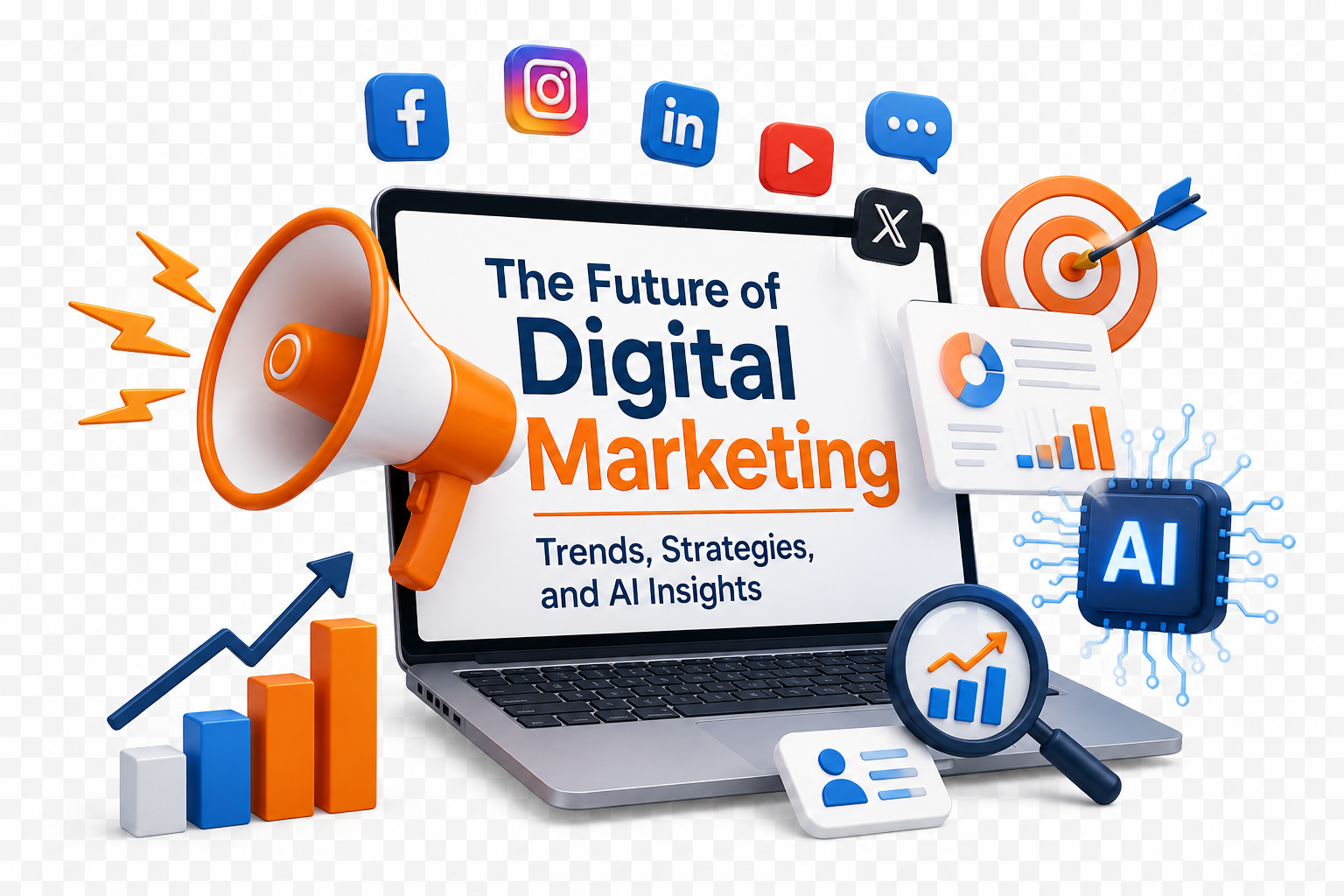
The Future of Digital Marketing: Trends, Strategies, and AI Insights Shaping Business Growth
A few years ago, I sat in a marketing planning meeting where someone confidently said, “Let’s just boost this post and run a few Google ads — that’s digital marketing sorted for the quarter.” Everyone nodded. Nobody questioned it. Fast forward to today, and that same sentence would get you laughed out of the room. The future of digital marketing isn’t about boosting posts anymore — it’s about predictive algorithms, hyper-personalized customer journeys, and AI systems that can write, design, and optimize campaigns faster than any human team.
If you’re a marketer, founder, or business owner wondering whether your current strategy will still work in two years, the honest answer is: probably not, at least not in its current form. The channels, the tools, and even the definition of “engagement” are shifting under our feet. This post breaks down where digital marketing is headed, why it’s changing so fast, and what you can actually do about it — no fluff, no recycled predictions.
Why the Future of Digital Marketing Matters Right Now
Marketing has always evolved, but the pace has never been this aggressive. According to McKinsey’s research on generative AI, generative AI alone could add trillions of dollars in value across marketing and sales functions by automating content creation, customer service, and personalization at scale.
At the same time, consumer expectations have changed. People don’t want to be marketed at — they want experiences that feel relevant, timely, and almost intuitive. A Salesforce State of the Connected Customer report consistently finds that a majority of customers expect companies to anticipate their needs, not just react to them.
That combination — powerful new tools plus rising customer expectations — is exactly why the future of digital marketing is being rewritten right now, not five years from now.
Traditional Marketing vs. the Future of Digital Marketing
Before diving into specific trends, it helps to see the shift side by side. Here’s how the old playbook compares to where things are heading:
| Aspect | Traditional Digital Marketing | Future of Digital Marketing |
| Targeting | Broad demographics, keyword-based ads | AI-driven micro-segmentation, predictive intent |
| Content Creation | Manual writing/design, slow turnaround | AI-assisted generation, real-time personalization |
| Customer Interaction | One-way messaging, static landing pages | Conversational AI, interactive and immersive experiences |
| Data Use | Historical reporting, quarterly reviews | Real-time analytics, predictive modeling |
| Search Behavior | Keyword-based Google search | Voice search, visual search, AI chat-based discovery |
| Privacy Approach | Third-party cookies, broad tracking | First-party data, consent-driven personalization |
| Channel Strategy | Fixed budget across few channels | Dynamic, AI-optimized cross-channel allocation |
This isn’t a minor upgrade — it’s a structural shift in how brands find, understand, and talk to their customers.
Key Trends Shaping the Future of Digital Marketing
1. AI-Powered Personalization Becomes the Baseline, Not the Bonus
Personalization used to mean inserting someone’s first name into an email subject line. That’s no longer enough. Today’s AI systems can analyze browsing behavior, purchase history, and even micro-signals like scroll speed to predict what a customer wants before they search for it.
Tools like Adobe Sensei and predictive engines built into platforms like HubSpot are already enabling brands to deliver dynamic website content, personalized product recommendations, and adaptive email journeys — all without a marketer manually configuring each segment.
What this means for you: If your personalization strategy still relies on static customer segments built quarterly, you’re already behind. The future belongs to real-time, behavior-triggered personalization.
2. Conversational and Voice-First Discovery
Search is no longer just typed into a box. Voice assistants, AI chat interfaces, and conversational commerce are reshaping how people discover products. Statista’s voice search data shows steady growth in voice assistant usage worldwide, and AI chat tools like ChatGPT and Google’s AI-powered search overviews are changing how people ask questions and expect direct answers rather than a list of blue links.
This has a direct SEO implication: content needs to answer questions conversationally and concisely, structured in a way that AI systems can easily extract and summarize.
Practical shift: Optimize for answers, not just keywords. Structure content with clear headers, FAQs, and direct responses to likely voice or chat queries.
3. First-Party Data Is the New Currency
With third-party cookies being phased out across major browsers and privacy regulations like GDPR and CCPA tightening data use, marketers can no longer rely on broad tracking. Google’s Privacy Sandbox initiative is one of the clearest signals that the ad-tech industry is moving toward privacy-first alternatives.
This means brands need to build direct relationships with customers — through loyalty programs, gated content, newsletters, and community platforms — to collect first-party data ethically and transparently.
I’ve seen small businesses that built strong email lists years ago suddenly find themselves at a massive advantage, simply because they weren’t dependent on third-party tracking that’s now disappearing.
4. Immersive and Interactive Experiences (AR, VR, and the Metaverse)
While the hype around the metaverse has cooled from its 2021-2022 peak, immersive technology hasn’t disappeared — it’s maturing into practical use cases. Brands like IKEA and Sephora use AR-powered try-before-you-buy features to reduce purchase hesitation and returns.
Augmented reality product previews, virtual showrooms, and interactive 3D content are becoming realistic tools for e-commerce brands, not just novelty experiments.
Where this is heading: Expect AR integration to become a standard feature in mobile shopping apps, particularly in fashion, furniture, and beauty industries where “seeing it in your space” drives conversion.
5. AI-Generated Content — With Human Oversight
AI tools can now draft blog posts, generate ad copy variations, and even produce short video content. But the brands winning with AI content aren’t the ones fully automating — they’re the ones using AI as a first draft and letting human editors add strategy, brand voice, and emotional nuance.
A useful mental model I’ve adopted: AI handles the “what,” humans handle the “why.” AI can generate ten headline variations instantly, but a human still needs to decide which one aligns with brand values and actually resonates emotionally with the target audience.
6. Predictive Analytics Over Historical Reporting
Traditional marketing dashboards tell you what happened last month. Future-ready marketing stacks use predictive analytics to forecast what’s likely to happen next — customer churn risk, optimal ad spend allocation, or which leads are most likely to convert.
Platforms increasingly bake this into their core offering rather than treating it as a premium add-on, signaling that predictive capability is becoming table stakes rather than a differentiator.
7. The Rise of Micro-Communities Over Mass Audiences
Interestingly, as AI scales personalization, there’s a parallel counter-trend: brands are investing more in small, engaged communities — Discord servers, private Slack groups, niche newsletters — rather than chasing mass reach alone.
This reflects a broader shift in consumer trust. People increasingly trust recommendations from peers and niche communities over polished brand advertising, which is why community-led growth is becoming a serious strategic pillar rather than a side project.
Smart Strategies to Prepare for What’s Next
Understanding trends is one thing — acting on them is another. Here are practical strategies businesses can start implementing now:
- Audit your data strategy. Identify how dependent you are on third-party cookies and start building first-party data channels immediately.
- Experiment with AI tools in low-risk areas first. Use AI for internal drafts, A/B test variations, or research summaries before scaling to customer-facing content.
- Invest in structured, answer-first content. This improves both traditional SEO and visibility in AI-powered search summaries.
- Build one genuine community touchpoint. This could be a newsletter, private group, or loyalty program — something that creates a direct relationship independent of algorithm changes.
- Set up basic predictive tracking. Even simple churn-prediction or lead-scoring models can dramatically improve resource allocation.
- Test one immersive feature if relevant to your industry. E-commerce brands especially should explore AR previews or interactive product demos.
Common Mistakes Businesses Make When Adapting
It’s worth naming a few traps I’ve seen brands fall into while trying to “future-proof” their marketing:
- Chasing every new tool. Adopting AI or AR just because it’s trendy, without a clear customer problem it solves, often wastes budget.
- Over-automating customer interactions. Removing human touch entirely can backfire, especially in industries where trust and relationships matter (healthcare, finance, high-ticket sales).
- Ignoring data privacy compliance. Personalization built on non-consensual data collection creates legal risk and erodes customer trust long-term.
- Treating AI content as “set and forget.” Unedited AI content often lacks nuance and can hurt brand credibility if it sounds generic or robotic.
What the Next Five Years Likely Look Like
Based on current trajectories across privacy regulation, AI capability, and shifting consumer behavior, here’s a realistic (not hype-driven) outlook:
- Search will fragment across traditional engines, AI chat interfaces, and voice assistants — requiring multi-format content strategies.
- Advertising will become more contextual and less tracking-dependent, pushing creative quality and contextual relevance back into focus.
- Marketing teams will shrink in size but grow in strategic capability, as AI absorbs repetitive tasks and human roles shift toward oversight, strategy, and creative direction.
- Trust and transparency will become genuine competitive advantages, not just compliance checkboxes.
None of this means marketing becomes fully automated or impersonal. If anything, the brands that win will be the ones that use AI to handle scale while doubling down on authentic human connection where it matters most.
Final Thoughts: Adapting Without Losing Your Brand’s Voice
The future of digital marketing isn’t a single technology or trend — it’s a combination of smarter tools, more demanding customers, and a marketplace that rewards genuine relevance over generic reach. The businesses that thrive won’t necessarily be the ones with the biggest budgets, but the ones willing to experiment thoughtfully, protect customer trust, and use AI as an amplifier rather than a replacement for human insight.
If there’s one thing worth remembering from all of this, it’s that technology changes the how of marketing far more than it changes the why. Customers still want to feel understood, valued, and respected — AI just gives us better tools to do that at scale.